


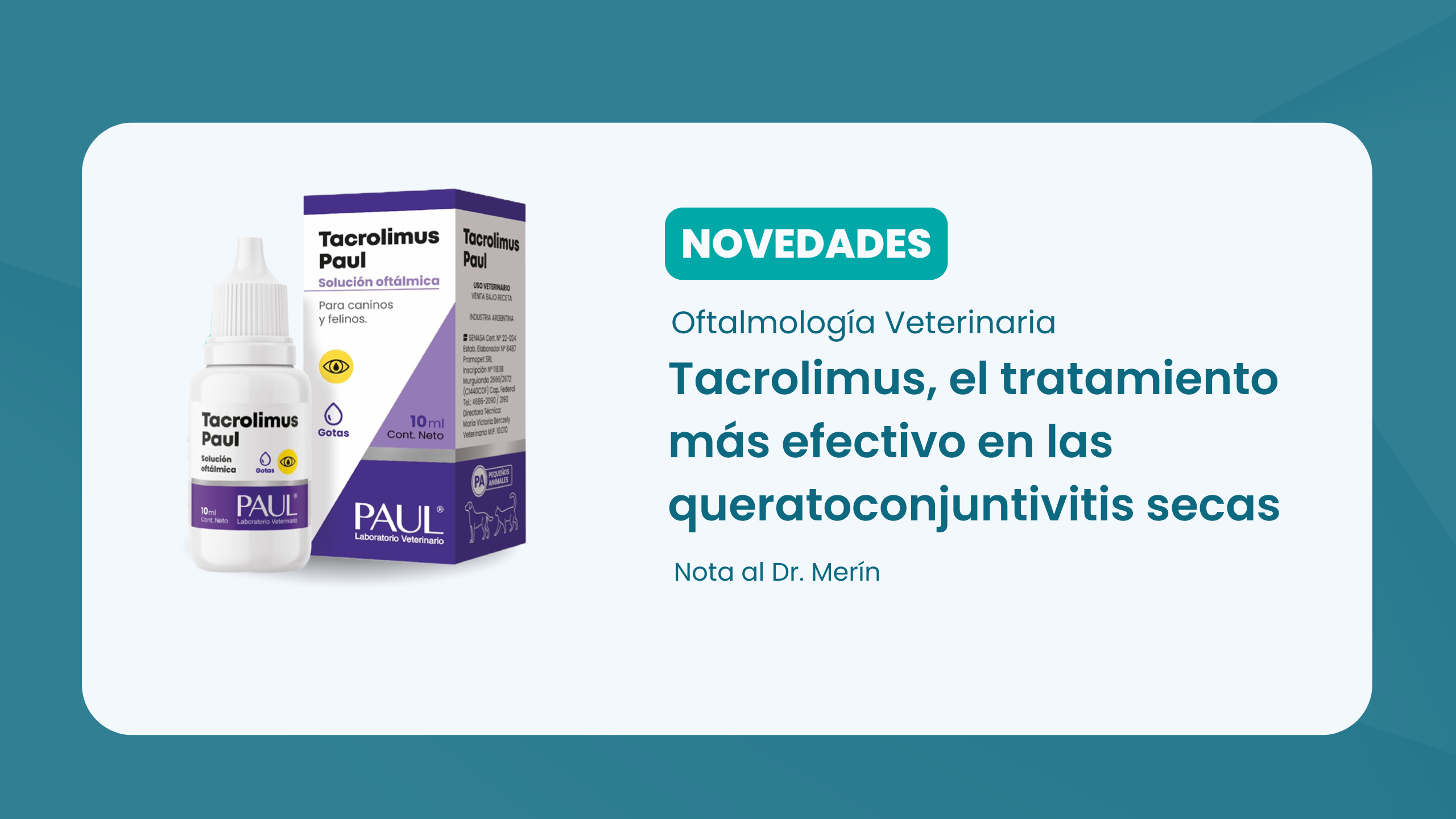
Tacrolimus has become one of the most effective therapeutic options for the management of keratoconjunctivitis sicca in veterinary medicine. Its efficacy is supported by its potency, rapid onset of action, and superior clinical recovery compared to previous treatments. . .
> .. . In a conversation with MOTIVAR magazine, Dr. Andrés Merín - veterinarian specialized in ophthalmology - explained the relevance of this molecule and highlighted that Paul Laboratory is the only laboratory in Argentina that understood the specific needs of veterinary ophthalmologists, investing in research and development to produce Tacrolimus as an ophthalmic solution, a formulation that has proven highly effective.
> “If the disease is not treated, it inevitably progresses to blindness through a very painful process. This drug is effective because it is an excellent immunomodulator and tear-production stimulant,” > —Dr. Andrés Merín
Dr. Merín recalled that, until a few years ago, cyclosporine was considered the best tear stimulant available: > “When cyclosporine was introduced, we thought it was the definitive solution to KCS, but it wasn’t enough. We needed a more efficient immunomodulator.”

He explained that veterinarians began exploring Tacrolimus after observing an unexpected side effect in human dermatological use. A patient applying a Tacrolimus cream for atopic dermatitis near the eyelid margin experienced significant tear production. This observation led to further investigation into its potential as a tear stimulant, prompting its incorporation into veterinary ophthalmology.
> . Paul laboratory embraced this opportunity and developed the veterinary formulation. Dr. Merín led the clinical validation studies, confirming its safety and effectiveness, and noting that its onset of action is considerably faster than other drugs previously used.
> “Unfortunately, until Paul Laboratory invested in Tacrolimus, we didn’t have access to this treatment in Argentina. It was already being used in Mexico, Peru, the United States, and Colombia,” > —Dr. Andrés Merín
Proven Results
According to Dr. Merín’s report for Paul Laboratory, Tacrolimus was introduced into veterinary ophthalmology as an immunosuppressant and a substitute for cyclosporine, and currently stands as the preferred option for advanced KCS cases. Tacrolimus is a macrolide antibiotic produced by Streptomyces tsukubaensis.
Regarding its mechanism of action, the drug acts as a calcineurin inhibitor—blocking a calcium-dependent enzyme involved in activating proteins responsible for lymphocyte growth and differentiation.

Multiple trials conducted on companion animals demonstrated highly satisfactory results.
In his clinical evaluation, Dr. Merín used: - Schirmer tear tests (Love Laboratory) - Fluorescein staining (Labyes) - Direct ophthalmoscopy - Tono-Pen Avia (Reichert) for applanation tonometry when required
Advantages in clinical use
Owners reported no difficulty administering the medication directly to the cornea. Prior to treatment, they were instructed on proper application techniques for ophthalmic solutions.
One notable advantage is that the formula is non-oily, allowing the drop to spread quickly—particularly beneficial for restless patients.
Additionally, none of the owners observed blepharospasm, palpebral mucosal congestion, or signs of irritation or pruritus during instillation. > Owners consistently reported rapid clinical improvement—often within just a few days—along with noticeable increases in patient comfort and well-being.